


Syllabus: GS1/ Society, GS3/ Economy
Context
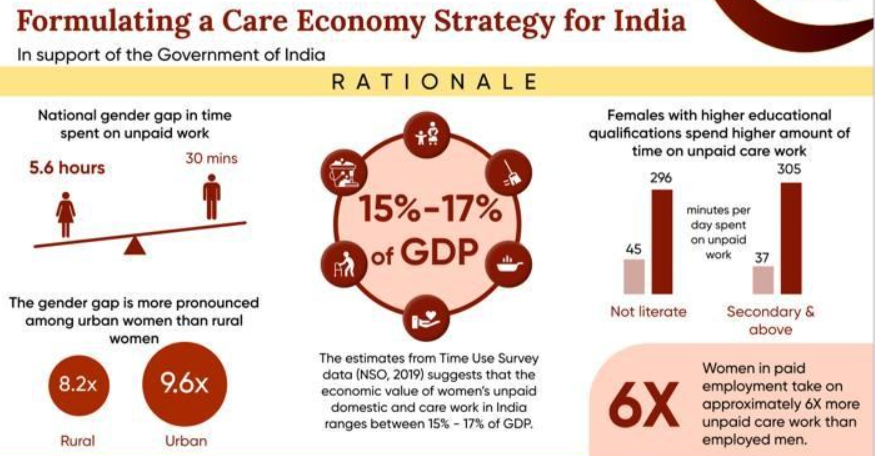
- A working paper by the Economic Advisory Council to the Prime Minister (EAC-PM) has laid out a roadmap to strengthen India’s “care economy”, a sector that includes childcare, eldercare, and support for people with disabilities.
What is the Care Economy?
- The care economy refers to all paid and unpaid activities related to the care of children, elderly persons, persons with disabilities etc.
- Care work forms a critical pillar of human development, labour productivity, and social welfare systems in modern economies.
- Future Projections: Evidence from the International Labour Organisation suggests that increasing investments in the care services sector have the potential to generate 475 million jobs globally by 2030.
- For India specifically, direct public investment equivalent to 2% of GDP can potentially generate 11 million jobs, nearly 70% of which will go to women.
Why is the Demand for Care Services Rising?
- Demographic Transition: India’s ageing population is increasing the need for long-term eldercare services.
- Urbanisation and Migration: Rapid urbanisation and migration are weakening traditional joint family systems. Nuclear families often lack informal support networks for caregiving.
- Rising Female Workforce Participation: More women entering the workforce has increased the demand for organised childcare and caregiving services.
Government Initiatives Related to the Care Economy
- Rashtriya Vayoshri Yojana: Provides physical aids and assisted-living devices for senior citizens with age-related disabilities.
- Mission Shakti: Mission Shakti aims to strengthen women’s safety, empowerment, and support systems, including childcare and social protection services.
- Integrated Child Development Services (ICDS): Launched in 1975 to provide early childhood care, nutrition, health services, and preschool education through Anganwadi centres.
- Targets children (0–6 years), pregnant women, and lactating mothers.
- Provides supplementary nutrition, immunization, health check-ups, and preschool education.
- POSHAN Abhiyaan (National Nutrition Mission): Focuses on reducing stunting, undernutrition, and Anaemia among women and children.
- Promotes behavioural change, use of technology (POSHAN Tracker), and convergence of health and nutrition services.
- Mission Shakti: Umbrella programme for women empowerment and safety.
- It includes schemes supporting childcare services and economic empowerment of women.
- Palna Scheme (National Crèche Scheme): It provides day-care facilities for children aged 6 months to 6 years.
- It offers nutrition, health care, and early learning support, helping mothers participate in the workforce.
- Operates under Mission Shakti with Centre–State funding support.
Challenges in Implementing Care Economy Reforms
- Fiscal Constraints: Expanding care infrastructure and workforce training requires substantial public investment and long-term financial commitment.
- Social Attitudes Towards Care Work: Caregiving continues to be viewed as a private family responsibility rather than a public policy concern.
- Deep-rooted patriarchal norms limit recognition of unpaid care work.
- Weak Regulatory Capacity: Ensuring quality standards and monitoring care institutions across India remains administratively challenging.
- Lack of Skilled Care Workforce: India faces a shortage of professionally trained caregivers, especially in eldercare, disability support, and early childhood care.
Way Ahead
- Recognise Care as Essential Social Infrastructure: Policymakers should treat care services as a core component of economic and social infrastructure similar to education and healthcare.
- Increase Investment in Care Services: India should substantially increase public investment in childcare centres, eldercare facilities, rehabilitation centres, and community support systems.
- Care policies should be aligned with labour reforms, gender budgeting, and women’s empowerment programmes.
- Improve Data Collection and Measurement: India should strengthen time-use surveys and statistical frameworks to estimate the economic contribution of unpaid care work.
Source: ET
Previous article
News In Short 06-05-2026
